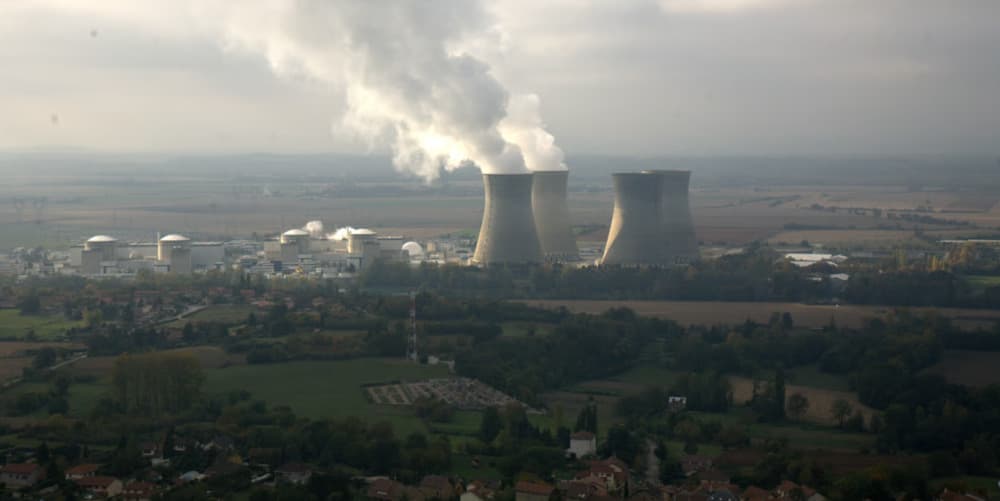
French President Emmanuel Macron’s nuclear revival strategy—anchored by the construction of six new-generation EPR2 reactors—could soon be amplified by up to eight additional units. While the initial six are already officially programmed, the potential eight remain subject to future government decisions, and local communities are now openly competing to host them. In recent statements, elected officials from Saint-Paul-Trois-Vallées (Drôme) and Creys-Mépieu (Isère) formally declared their readiness to welcome a share of these extra reactors, signaling a notable shift in public and political attitudes toward atomic energy.
The candidacies carry historical weight. Saint-Paul-Trois-Vallées is home to the Tricastin nuclear power plant, a large operational site with four 900 MWe pressurized water reactors. Creys-Mépieu houses the Creys-Malville site, where the 1,200 MWe Superphénix fast breeder reactor operated until 1997 and is now undergoing decommissioning. Both areas thus possess existing nuclear infrastructure, a technically skilled workforce, and established logistical frameworks that would facilitate new construction. By volunteering, their representatives are underlining that the long-debated “acceptability” of nuclear power—tested after decades of controversy over waste, safety, and cost—is evolving, especially in territories that have coexisted with the industry.
France’s EPR2 program is a cornerstone of its energy sovereignty and decarbonization agenda. EPR2 is an optimized version of the European Pressurized Reactor, designed to be simpler and cheaper to build than its predecessor, with a target construction cost 30% lower per unit. The first pair of the six already confirmed EPR2s is slated for Penly (Seine-Maritime), followed by Gravelines (Nord) and either Bugey (Ain) or Tricastin (Drôme). The additional eight reactors, mentioned by Macron in early 2023 as a “possibility” depending on feasibility studies and financing, would bring the total new fleet to 14 units. While no timeline or formal site selection has been announced for the extra batch, the proactive stance of these two municipalities could influence the government’s calculus.
The statements by the local officials underscore a broader trend: regions that once fiercely opposed nuclear projects are now seeing economic opportunity in hosting them. For Creys-Mépieu, where the memory of Superphénix’s technical problems and closure is still vivid, the willingness to consider new EPR2 reactors is particularly striking. It suggests that the promise of thousands of construction jobs, long-term operational employment, and tax revenues is reshaping local debates. Moreover, the French nuclear safety authority (ASN) has indicated that reusing existing nuclear sites simplifies licensing and environmental assessments, making these candidacies logistically attractive.
As France prepares to relaunch a large-scale nuclear construction program unseen since the 1990s, such locally driven endorsements may help smooth public consultation and parliamentary approval processes. However, they also raise questions about national coordination: with multiple sites vying for reactors, the government will need to weigh technical suitability, grid capacity, cooling water availability, and regional economic balance. The expression of interest from the Drôme and Isère municipalities solidifies the notion that nuclear power, once a divisive electoral issue, is increasingly reframed as an industrial and climate asset by the communities that would bear its immediate footprint.