法国原子能与替代能源委员会(CEA)与欧几里得卫星携手探索宇宙暗物质与暗能量

Le CEA et le satellite Euclid pour explorer la matière et l’énergie noires de l’Univers

CEA Enterprise 2023-06-30 10:00 Original
摘要
欧洲空间局(ESA)的欧几里得太空望远镜将于2023年7月1日由美国SpaceX公司的猎鹰9号火箭从佛罗里达州卡纳维拉尔角发射升空。法国原子能和替代能源委员会(CEA)深度参与了卫星上两个关键仪器(可见光成像相机VIS和红外光谱光度计NISP)的研制,并负责开发了任务的地面部分系统。

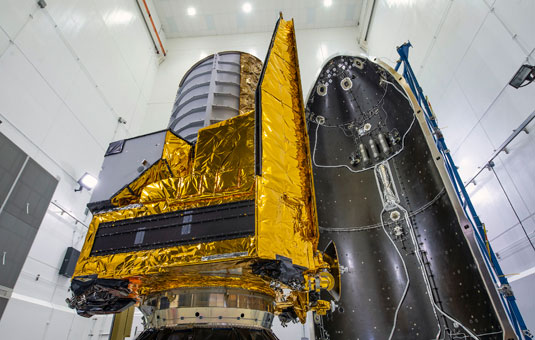
2023年7月1日,欧洲空间局(ESA)的欧几里得(Euclid)空间望远镜将由美国SpaceX公司的猎鹰9号火箭,从佛罗里达州卡纳维拉尔角发射升空。该任务的核心目标是以前所未有的精度绘制宇宙大尺度结构,以探索暗物质和暗能量——这两种成分共同构成了宇宙总质能的大约95%,但其本质仍是现代物理学最大的谜团之一。

法国原子能与替代能源委员会(CEA)作为欧几里得任务的关键参与者,深度贡献于卫星的两个核心科学仪器:可见光成像仪(VIS)和近红外光谱光度计(NISP)。VIS将提供极高分辨率的可见光图像,用于精确测量数十亿星系的形状,通过弱引力透镜效应探测暗物质的分布。NISP则将在近红外波段工作,通过测量星系的红移来构建宇宙的三维地图,并研究宇宙的膨胀历史,从而揭示暗能量的性质。

除了仪器硬件,CEA还参与了任务地面段系统的开发,包括数据处理管道和科学分析软件的构建。欧几里得任务预计将进行为期六年的观测,产生海量数据,有望为理解宇宙的组成和演化带来革命性突破。

Summary
The European Space Agency's Euclid space telescope, equipped with instruments developed by France's CEA, is scheduled for launch on July 1, 2023, aboard a SpaceX Falcon 9 rocket from Cape Canaveral. The mission aims to study dark matter and dark energy, with the CEA contributing to its visible-light camera, infrared spectrometer, and ground segment systems.

The European Space Agency's Euclid space telescope is scheduled for launch aboard a SpaceX Falcon 9 rocket from Cape Canaveral, Florida, on July 1, 2023. Its primary mission is to investigate the nature of dark matter and dark energy, which together constitute about 95% of the universe's total mass-energy content but remain poorly understood.

France's Atomic Energy and Alternative Energies Commission (CEA) has played a significant role in the mission's development. The agency contributed to both of Euclid's core scientific instruments: the VISible instrument (VIS), a high-resolution optical imaging camera, and the Near-Infrared Spectrometer and Photometer (NISP). Additionally, the CEA was involved in developing the ground segment of the mission, which includes the data processing and analysis infrastructure essential for interpreting the vast datasets Euclid will generate.

Résumé
Le télescope spatial Euclid sera lancé le 1er juillet 2023 par une fusée Falcon 9 depuis la Floride. Le CEA a contribué aux deux instruments scientifiques du satellite (VIS et NISP) ainsi qu'au segment sol de la mission.

​Le 1er juillet 2023, le télescope spatial Euclid sera lancé par une fusée Falcon 9 depuis la base de lancement de Cape Canaveral en Floride, aux Etats-Unis. Le CEA a participé aux deux instruments à bord du satellite : VIS, la caméra imageant dans le visible et NISP, spectrophotomètre en infrarouge, mais aussi au développement de la partie segment sol de la mission.

AI Insight
Core Point

The CEA helped develop key instruments and ground systems for ESA’s Euclid space telescope, which will study dark matter and dark energy, making this a notable European space-science and advanced instrumentation milestone.

Key Players

CEA — French public research organization focused on energy, defense, and advanced technologies; based in France.

Euclid / ESA — European space telescope mission and space agency; based in Europe.

SpaceX — Launch provider for Euclid’s Falcon 9 launch; based in the United States.

Industry Impact
  • Computing/AI: Medium — mission data processing and scientific analysis will rely on advanced computing.
  • ICT: Medium — space instrumentation and ground segment systems depend on high-end communications and data infrastructure.
Tracking

Monitor — important for European space tech and scientific instrumentation, but limited immediate commercial impact.
Related Companies
CEA-Leti
CEA-Leti mature
positive
neutral
neutral
Categories
航空航天 科研
AI Processing
2026-03-31 10:53
deepseek / deepseek-chat