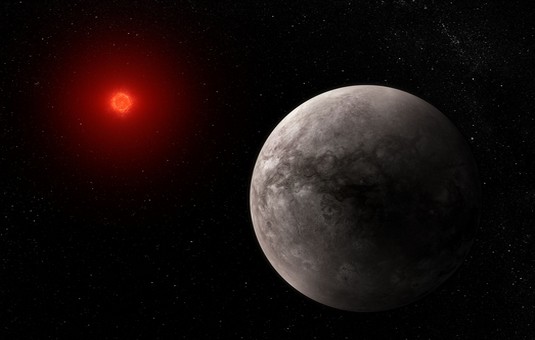
韦伯望远镜首次探测到地球"表亲"行星的光线

La lumière d'une planète cousine de la Terre détectée pour la première fois grâce à Webb

CEA Enterprise 2023-03-27 10:00 Original
摘要
美国宇航局、加州大学圣克鲁兹分校和法国原子能与替代能源委员会的研究团队成功探测到了来自温带岩石系外行星Trappist-1b的光线,这是全球首次实现此类探测。该突破借助了由法国原子能与替代能源委员会设计、搭载于韦伯太空望远镜的Mirim成像仪完成,相关成果已发表于2023年3月27日的《自然》杂志。

美国国家航空航天局(NASA)、加州大学圣克鲁兹分校(UCSC)以及法国原子能与替代能源委员会(CEA)的研究团队近日成功探测到来自岩质温带系外行星Trappist-1b的光信号。这是全球首次实现对岩质温带系外行星发光现象的探测。

此次突破性观测得益于搭载于詹姆斯·韦伯太空望远镜上的中红外成像仪(Mirim),该仪器由CEA主导研制。相关研究成果已于2023年3月27日发表在《自然》期刊。

Trappist-1b作为Trappist-1星系中最内侧的行星,其轨道周期仅1.5个地球日,与恒星距离仅为日地距离的百分之一。尽管该行星处于潮汐锁定状态(一面永久朝向恒星),其昼侧温度仍达约500摄氏度,远高于此前“温带行星”的预期范围。

研究团队采用创新性的“二次日食”观测法,通过对比行星运行至恒星背后前后的红外波段数据,成功剥离恒星辐射干扰,首次捕获到该系外行星自身的热辐射信号。数据分析显示,Trappist-1b昼侧温度分布极不均匀,表明其可能缺乏全球性大气环流系统。

这项发现标志着系外行星研究进入新阶段:韦伯望远镜首次证明其具备直接探测岩质系外行星热辐射的能力,为未来研究Trappist-1星系中其他可能宜居行星(如Trappist-1e)的大气成分奠定了方法论基础。研究人员强调,此次观测虽未检测到大气层存在证据,但为后续探寻类地行星大气特征开辟了全新路径。

Summary
A team from NASA, UC Santa Cruz, and France's CEA has successfully detected light from TRAPPIST-1b, marking the first-ever detection of thermal emissions from a rocky, temperate exoplanet. The discovery was made using the MIRI instrument, designed by the CEA and onboard the James Webb Space Telescope. The findings, published in *Nature*, represent a significant advancement in the study of exoplanet atmospheres and potential habitability.

NASA, University of California Santa Cruz (UCSC), and France's CEA researchers have successfully detected light from the rocky, temperate exoplanet Trappist-1b—the first such detection of thermal emission from a rocky, Earth-like world beyond our solar system. The breakthrough was achieved using the MIRI instrument aboard the James Webb Space Telescope, whose Mid-Infrared Imager (MIRIM) was designed and built by the CEA.

The findings, published in the March 27, 2023, issue of *Nature*, mark a pivotal step in exoplanet science. While Trappist-1b is likely too hot to host liquid water due to its close orbit around its cool red dwarf star, the detection demonstrates Webb’s unprecedented capability to study the atmospheres and surface conditions of small, rocky planets. This opens the door to future observations of other planets in the Trappist-1 system, several of which orbit within the star’s habitable zone.

Résumé
Une équipe de la NASA, de l'UCSC et du CEA a réalisé la première détection mondiale de lumière émise par une exoplanète rocheuse et tempérée, Trappist-1b, grâce à l'instrument Mirim du CEA embarqué sur le télescope spatial James Webb. Cette percée, publiée dans Nature, ouvre de nouvelles perspectives pour l'étude des atmosphères et des conditions de planètes similaires à la Terre.

​Une équipe de chercheurs de la NASA, de l’Université de Californie à Santa Cruz (UCSC) et du CEA a détecté avec succès de la lumière provenant de Trappist-1b, une exoplanète rocheuse tempérée. C’est la première fois au monde qu’une émission lumineuse d’une exoplanète rocheuse et tempérée est détectée. Cette détection a eu lieu grâce à l'imageur Mirim, conçu par le CEA et embarqué dans le télescope spatial Webb. Ces résultats sont publiés dans la revue Nature du 27 mars 2023.

AI Insight
Core Point

NASA, UCSC, and CEA used Webb’s MIRI instrument to detect light from the rocky exoplanet TRAPPIST-1b for the first time, a milestone that advances exoplanet characterization and Webb’s scientific value.

Key Players

NASA — U.S. space agency, based in the United States.

University of California, Santa Cruz (UCSC) — research university, based in Santa Cruz, California, USA.

CEA — French public research organization, based in France.

James Webb Space Telescope (Webb) — space observatory, operated by NASA/ESA/CSA, based in space.

Industry Impact
  • Computing/AI: Low — advanced data analysis and space instrumentation.
  • ICT: Medium — strengthens high-end space imaging and scientific instrumentation.
  • Energy: Low — relevant only indirectly through planetary climate research.
Tracking

Monitor — important scientific validation for Webb and exoplanet research, but limited immediate commercial impact.

Highlights
Tech Breakthrough
Categories
航空航天 科研
AI Processing
2026-03-31 10:53
deepseek / deepseek-chat